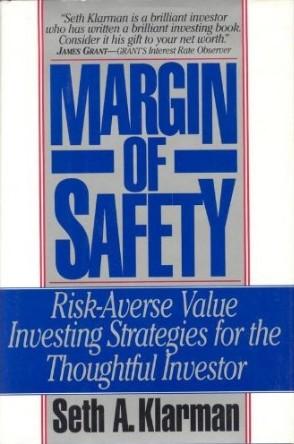
Author: Seth A. Klarman
Published: 1991
Pages: 249
Status: Out of print — secondary market $1,500+
Difficulty: Intermediate to Advanced
"Value investing is at its core the marriage of a contrarian streak and a calculator." — Seth Klarman
Why This Book Matters
Margin of Safety occupies a unique position in investment literature. It is simultaneously the most in-demand and the least available book on value investing. Seth Klarman — who manages over $30 billion at the Baupost Group — wrote it in 1991, printed a limited run, and has never authorized a reprint.
The book matters because it bridges the gap between Graham's academic framework and the practical realities of modern markets. Graham wrote in an era of manual balance sheet analysis and limited market data. Klarman writes in a world of index funds, institutional investors, leveraged buyouts, and 24-hour financial news. He shows that Graham's principles not only survive in this environment — they work better, because the institutional investment industry creates exactly the kind of mispricings that value investors exploit.
Klarman's central argument is deceptively simple: the primary goal of investing is to avoid losing money. Everything else — including making money — follows from this principle. This is Graham's margin of safety concept taken to its logical extreme and applied with three decades of real-world performance to back it up.
About Seth Klarman
Seth Andrew Klarman (born 1957) is the founder and CEO of The Baupost Group, a Boston-based investment partnership that manages approximately $30 billion. Since founding Baupost in 1982, Klarman has compounded at roughly 20% annually — a track record that places him among the greatest investors in history.
What makes Klarman's record extraordinary is not just the returns but the risk profile. Baupost routinely holds 30-50% of its portfolio in cash, waiting for opportunities. In years when the market rises sharply and Baupost is heavily in cash, the fund underperforms. But over full market cycles — including crashes — the combination of cash reserves and deep-value investing produces exceptional risk-adjusted returns.
Klarman is a direct intellectual descendant of Benjamin Graham. He studied under value investor Bill Ruane at Harvard Business School, and he wrote the foreword to the sixth edition of Security Analysis. His approach is fundamentally Graham-Dodd, adapted for a modern institutional landscape.
Key Concepts
Margin of Safety is organized around five core ideas:
- Most investors are their own worst enemy — Speculation disguised as investing destroys more wealth than bear markets.
- The institutional investment industry is structurally broken — Incentive misalignment, benchmark obsession, and short-termism prevent professional managers from investing rationally.
- Value investing works because it is psychologically difficult — If it were easy, everyone would do it, and the edge would disappear.
- Downside protection matters more than upside potential — Avoid losses first; gains take care of themselves.
- The margin of safety is not just a calculation — it is a worldview — Always leave room for error, surprise, and bad luck.
Institutional Folly
Klarman's most original contribution is his dissection of why the institutional investment industry systematically destroys value. This analysis remains startlingly relevant decades later.
The benchmark trap: Mutual fund managers are judged against the S&P 500 quarterly. This creates irresistible pressure to stay fully invested and to hold the same stocks as the index. A manager who holds cash during a bubble will underperform and lose clients — even if holding cash is the rational decision. The result: institutional managers are structurally incapable of waiting for bargains.
The career risk problem: An institutional manager who buys an unpopular, out-of-favor stock and is wrong loses their job. A manager who buys a popular stock and is wrong can say "everyone else owned it too." This asymmetry pushes institutional money toward consensus positions and away from contrarian opportunities — exactly where value is found.
The size curse: Large funds must deploy billions of dollars. This eliminates small-cap, special situation, and distressed opportunities that offer the highest returns. The bigger the fund, the more it must behave like an index.
Klarman's conclusion: individual investors have a structural advantage over institutions. You can hold cash without being fired. You can buy unpopular stocks without answering to a committee. You can wait years for the right opportunity without quarterly performance reports. This advantage is permanent, because the institutional constraints that create it are built into the structure of the industry.
Downside First, Upside Second
The book's title is its thesis. Klarman argues that most investors — professionals and individuals alike — focus on the wrong question. They ask "how much can I make?" before asking "how much can I lose?"
This inversion is the defining characteristic of value investing:
- Before analyzing upside potential, check for bankruptcy risk. A stock that might double but could also go to zero is not an investment — it is a gamble.
- Before estimating fair value, stress-test your assumptions. What if earnings decline 30%? What if the growth rate drops to zero? If the stock still looks reasonable under pessimistic assumptions, you have a genuine margin of safety.
- Before buying anything, ask what could go wrong. Not what probably will go wrong — what could go wrong. The margin of safety protects you against the improbable, not just the expected.
This is the philosophy behind FairValueLabs' Risk Audit. Before evaluating any stock's upside potential, we screen for bankruptcy risk using the Altman Z-Score. A company in the distress zone is eliminated from consideration regardless of how cheap it looks. Klarman would approve: avoiding the losers is more important than finding the winners.
Where Value Investors Look
Klarman identifies specific categories where value opportunities concentrate:
Corporate spinoffs — When a large company divests a division, the spun-off entity often trades at a discount because institutional investors sell it automatically (it doesn't fit their mandate, it's too small, it's in an unfamiliar industry).
Distressed and bankrupt securities — When a company enters bankruptcy, most investors flee. But the assets don't disappear — they get repriced. Patient investors who analyze the liquidation value and restructuring plan can buy assets at steep discounts.
Risk arbitrage and liquidations — Special situations where the return depends on a corporate event (merger, tender offer, liquidation) rather than market direction. These require specialized knowledge but offer returns uncorrelated with the market.
Thrift conversions and forced selling — Situations where sellers act from necessity rather than analysis. When an index removes a stock, index funds must sell regardless of price. When an estate liquidates, the executor sells at market. These create mechanical mispricings.
The common thread: value is found where other investors are forced to sell, prohibited from buying, or psychologically unwilling to act. The market is most irrational at the margins — and that is where value investors operate.
How FairValueLabs Applies These Ideas
| Klarman's Concept | FairValueLabs Tool | What It Does |
|---|---|---|
| Downside protection first | Risk Audit | Screens for bankruptcy risk before valuation |
| Margin of safety | Fair Value Lab | Multi-method valuation with conservative assumptions |
| Avoid value traps | Value Trap Detection | Identifies cheap stocks with deteriorating fundamentals |
| Contrarian positioning | Undervalued Stocks | Finds stocks trading below intrinsic value |
| Cash as a strategic asset | Strike Zone | Highlights only when all criteria align — implying "wait" when nothing qualifies |
Klarman demonstrated that Graham's 1949 framework does not merely survive in modern markets — it thrives. The institutional machinery of Wall Street creates more mispricings, more forced selling, and more psychological pressure to act irrationally than Graham could have imagined. For patient, disciplined investors, that is good news.