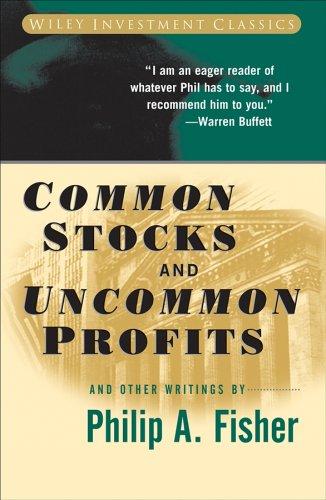
Author: Philip A. Fisher
First Published: 1958
Pages: 320
Publisher: Wiley (2003 edition with foreword by Philip Fisher's son, Ken Fisher)
Difficulty: Beginner to Intermediate
"I am 85% Benjamin Graham and 15% Philip Fisher." — Warren Buffett
Why This Book Matters
Benjamin Graham taught the world to look at the balance sheet. Philip Fisher taught the world to look at the business.
When Common Stocks and Uncommon Profits was published in 1958, the investment world was divided into two camps: the Graham disciples who analyzed financial statements, and everyone else who followed tips and market momentum. Fisher opened a third path — rigorous analysis of qualitative factors that balance sheets cannot capture: management integrity, R&D strength, competitive moats, and growth potential.
This matters because the greatest investments in history — Coca-Cola, Apple, Visa, Costco — were never "cheap" by Graham's strict quantitative criteria. They were outstanding businesses that compounded wealth for decades. Fisher's framework explains why these investments worked and gives you the tools to identify similar opportunities.
Buffett credits Fisher with a critical evolution in his thinking. After meeting Munger — who reinforced Fisher's quality-first philosophy — Buffett shifted from buying mediocre businesses at bargain prices to buying excellent businesses at fair prices. The result: Berkshire Hathaway.
About Philip Fisher
Philip Arthur Fisher (1907–2004) founded the investment counseling firm Fisher & Company in 1931 — in the depths of the Great Depression. He ran it for over 60 years, focusing on innovative growth companies in technology and chemicals.
Fisher was notoriously private. He rarely gave interviews, never courted publicity, and managed a small client base rather than building a large firm. His investment approach required deep research into each company — understanding the business as thoroughly as an insider — which limited the number of positions he could hold.
His most famous investment was Motorola, which he bought in 1955 and held until his death in 2004 — nearly 50 years. This single investment illustrates his core philosophy: find an outstanding company, buy it at a reasonable price, and hold it as long as the business fundamentals remain strong.
The Scuttlebutt Method
Fisher's most distinctive contribution is the "scuttlebutt" method — a systematic approach to gathering intelligence about a company from sources beyond its financial statements.
The process:
- Talk to competitors — What do rival companies say about this business? If competitors respect and fear a company, that's a strong signal.
- Talk to customers — Are they loyal? Would they switch to a competitor? Why or why not?
- Talk to suppliers — Is the company a good partner? Does it pay on time? Is it growing its orders?
- Talk to former employees — Why did they leave? What is the internal culture like? Is R&D genuinely innovative or just maintaining existing products?
- Talk to industry experts — Academics, trade journalists, conference attendees who understand the competitive landscape.
The goal is to triangulate reality from multiple independent perspectives. Financial statements tell you what happened last quarter. Scuttlebutt tells you what will happen next decade.
While individual investors cannot replicate Fisher's extensive network, the principle translates: read customer reviews, study competitor earnings calls, follow industry publications, attend shareholder meetings. The more perspectives you gather, the better your understanding of the business.
The 15 Points to Look for in a Stock
The core of Fisher's framework is a checklist of 15 qualitative criteria. A company that scores well on most of these is a candidate for long-term investment:
- Does the company have products with sufficient market potential to enable growth for years?
- Does management have the determination to develop new products when current ones are mature?
- How effective is the company's R&D relative to its size?
- Does the company have an above-average sales organization?
- Does the company have a worthwhile profit margin?
- What is the company doing to maintain or improve profit margins?
- Does the company have outstanding labor and personnel relations?
- Does the company have outstanding executive relations?
- Does the company have depth to its management?
- How good are the company's cost analysis and accounting controls?
- Are there other aspects of the business that give the investor clues about competitive standing?
- Does the company have a short-range or long-range outlook on profits?
- Will growth require equity financing that dilutes existing shareholders?
- Does management talk freely about operations when things are going well but clam up when problems arise?
- Does the company have a management of unquestionable integrity?
Point 15 is non-negotiable. Fisher would eliminate any company where management integrity was questionable, regardless of how well it scored on the other 14 points. This mirrors Buffett's famous test: "We look for three things in a person — intelligence, energy, and integrity. If they don't have the last one, the first two will kill you."
When to Sell — and When Not To
Fisher was one of the first investors to articulate a disciplined approach to selling. He identified only three valid reasons to sell a stock:
-
You made a mistake — Your original analysis was wrong. The business is not what you thought it was. Sell immediately and move on. The biggest investment mistakes come from holding onto errors out of pride.
-
The company no longer meets the 15-point criteria — Management has deteriorated, competitive advantage has eroded, or growth potential has been exhausted. This is not a short-term earnings miss — it is a fundamental change in the business.
-
A significantly better opportunity exists — You find another investment that offers clearly superior long-term potential. Fisher warned that this reason is overused — investors constantly rotate into "better" ideas, destroying the compounding benefits of long-term holding.
Critically, Fisher argued that short-term price declines are never a reason to sell. If the business is unchanged, a lower price is an opportunity to buy more, not a signal to exit. This principle — which Buffett and Munger adopted wholeheartedly — is the foundation of patient, conviction-based investing.
How FairValueLabs Applies These Ideas
| Fisher's Concept | FairValueLabs Tool | What It Does |
|---|---|---|
| Management quality | Moat Ratings | ROIC consistency reflects management capital allocation skill |
| Competitive advantage | Economic Moat Analysis | Quantifies the durability of competitive positioning |
| Growth sustainability | Fair Value Lab | Forward-looking valuation based on earnings trajectory |
| R&D and innovation | Stock Analysis Pages | Industry positioning and growth metrics |
| Selling discipline | Value Trap Detection | Identifies when fundamentals have deteriorated |
Fisher's 15-point checklist was qualitative and required extensive field research. FairValueLabs translates the quantifiable elements of his framework into systematic screening tools — so you can apply Fisher's rigor to every stock in the market, not just the handful you have time to research personally.